I grew up in Bangkok. There was one television in the house, and it lived in my parents’ bedroom, upstairs.
Some time in the late 1980s, Channel 3 started running a Hong Kong serial dubbed into Thai. Its Chinese title was Shanghai Tan — 上海滩, roughly ‘the Bund.’ The title on Thai television, the one I actually grew up saying, was Chao Por Xiang Hai: ‘Godfather of Shanghai.’ Most days I rode the school bus home, and most days, the moment it dropped me at the corner, I ran — not for the snack my mother left out, but for the stairs, and the television at the top of them.
My father often watched with me, and he was doing something I did not understand until I was much older. The dialogue was dubbed into Thai. The shopfront signs, the newspaper headlines, the calligraphy on scrolls in the background, were not — they stayed in Chinese, the way subtitles survive underneath a bad dub. My father read them. He had been given a Chinese name at birth and raised speaking Teochew before he was made, quickly and thoroughly, to speak Thai: a second-generation Hua-qiao child coming of age at a moment when the Thai state wanted its Chinese minority visibly, legally, unmistakably Thai. He did what the era asked of him. He did not, it turns out, forget what came before it.
I did not know, at the time, that I was watching my father read.
I would like to say that I was drawn to it by an early curiosity about Chinese urban modernity. I was drawn to it by the fighting.
Other things got in while I was watching the fighting.
The trams got in. So did the arcades along the waterfront, the rain on the stone, the way a street could look expensive and dangerous in the same shot. So did Xu Wenqiang — clever, beautifully dressed, unhurried, the sort of man who wins an argument by not raising his voice. I tried to model myself on him. I was a short Thai boy with a bowl cut. It did not go well.
But the character I have thought about for the rest of my life is Ding Li.
Ding Li starts at the bottom. In the version I remember, he comes out of the alleyway houses of the old city, doing the work nobody wants — the buckets, the night soil, the labour that a city performs on itself before dawn and prefers not to discuss. By the end he is one of the most powerful men in the most important city in Asia.
I did not know the word for those alleys. I did not know they had a name, a history, a building type, a literature, or a fight going on over whether they should be demolished. I would not learn the word lilong for another eighteen years.
So the object of this book arrived in my life before its name did. It arrived on a small television, dubbed into Thai, at the top of a staircase in my parents’ house.
There is a second thing I did not know, and it is a larger one.
I grew up believing I was mostly Thai — Thai with, somewhere upstream, a modest and diluted amount of Chinese blood, the kind of ancestry a lot of Bangkok families claim without much specificity. I had the fraction wrong. I am, as far as three generations of paperwork and one very patient older relative have been able to establish, entirely Chinese. Teochew, specifically, tracing to a village near Chaozhou, in what is now Guangdong province. The area my family still calls Chan-Tou — their own transliteration, not one I can match to a modern map. Some time in the early twentieth century, an ancestor of mine got on a boat off the Chaozhou coast — one of many hundreds of thousands of Teochew migrants who made that crossing to Siam in the same decades — and arrived with nothing that survives in family memory as a name, a trade, or a plan. He or she did not die of poverty or fever in a fishing village in the Chaoshan hills, which by any reasonable estimate was the likelier outcome. He or she died, eventually, in Thailand, having had children.
Those children became my grandparents. My grandparents worked constantly, saved compulsively, and were — by the affectionate, exhausted consensus of everyone left in the family who remembers them well enough to say so — stingy as hell. They believed in hard work the way other households believe in a religion, and they pushed their own children, my parents’ generation, hard enough that by the time I was born the pushing had softened into something kinder. My parents were both white-collar. I was, by my grandparents’ standard, spoiled. I inherited the belief in hard work anyway. It seems to survive the softening.
Do the arithmetic and it comes to this: four generations removed from a Teochew boatman who could not read, did not speak Mandarin, and had no way of knowing whether the crossing would kill him, his great-grandson finished a doctorate at Harvard. By the time I understood any of this clearly, I had already spent years writing an ethnography of a Shanghai neighbourhood I had fallen for, as a child, through a television in my parents’ bedroom. It took me an embarrassingly long time to notice that I was also writing about where I came from. Chaozhou is a long day’s drive from Shanghai. It is closer to my own history than the city I spent a decade studying. I intend to go. I have also started, at an age when this is supposed to be much harder than it apparently is, to learn Teochew.
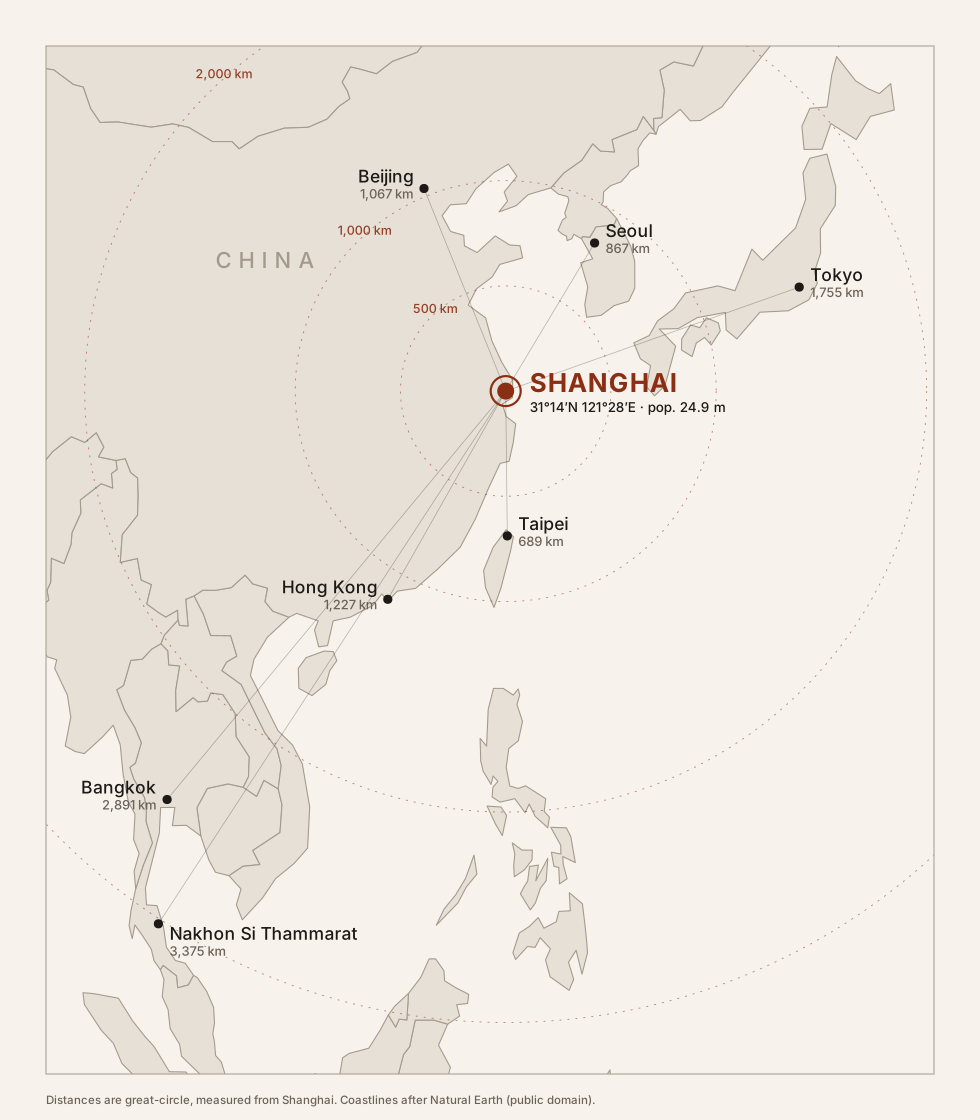
Since this is the point at which most readers will want to know what kind of place we are actually talking about, here are the numbers, once, with their sources attached.
I want to be plain about method here, because the rest of the book will not stop to defend itself. What follows is qualitative work. It is one compound, roughly two hundred houses, around three thousand people, and one anthropologist who lived among them badly and then well. It is not a survey and it does not pretend to be one. But qualitative is not the same as unaccountable, and it has been treated as if it were.
For a long time a certain kind of anthropology has run on a three-part practice: I come, I criticise, I leave. The researcher arrives with a theory already packed; spends a season close enough to quote people and far enough to remain unaccountable to them; extracts a critique that the field is then asked to illustrate; anonymises the evidence past the point at which anyone else could walk back to it; and publishes. The anonymisation is justified as protection of informants, and sometimes it is. It is also, too often, a design. A study that cannot be retraced cannot be contradicted. A study that cannot be contradicted is not qualitative method. It is a licence to invent a field that will ratify a claim the author already held. The people in the notes cannot answer, because they have been written out of the address book on ethical grounds. The city cannot answer, because the researcher has already gone home. That is not a superpower. It is a closed loop.
This book is the response to that practice. Everything in these chapters is either something I watched, something I was told and can attribute, or something I looked up and have cited. Where I am inferring, I say so. Where I got something wrong at the time, I have left the error in and put the correction in a note. The number of things I confidently believed in 2014 and no longer believe is not small. The compound has a gate that still opens. The neighbours still have opinions. I have gone back. If a claim in this book cannot survive a walk down the eighth lane, it does not belong in the book.
Everything after that is Hong Kong’s fault too. Hong Kong cinema was the water I grew up in — the framing, the tailoring, the rain, the loyalty plots, the conviction that a city is a place where a person can be reinvented if they are quick enough. It is not a bad training for an urban anthropologist. It is certainly not a worse one than the theory I was given later.
I got to the actual Shanghai in the summer of 2006. I was there for one week, with a joint MIT–Tsinghua urban-design studio, and I left with a small obsession that had not been there when I arrived. I will come back to that week.
Coming Back
What does it feel like to come back to a city you stopped being able to come back to?
I had been visiting Shanghai every year since 2006. There was one exception: 2010, the year of the World Expo, the year my father died. Then there was a longer exception. The pandemic closed the country in early 2020 and kept it closed, for the practical purposes of a Thai national with a research visa, until well into 2023. By the time I was able to return, I had been away for nearly four years. It was the longest gap in my Shanghai life. The return is the reason this book exists at all.
I came back, in the autumn of 2023, the long way. The week before, I had been at the Smart City Expo World Congress in Changsha. It was the first time China had hosted a regional edition of the conference. Changsha is a Hunan provincial capital, and in the years I was away it had become a city I would not have recognised.
From Changsha I took a high-speed train to Shenzhen. I spent three days there, visiting friends and walking through factories, trying to see what digital-economy work looked like at the scale that was by then producing most of the consumer hardware sold anywhere on the planet. From Shenzhen I took an overnight train to Shanghai’s Hongqiao station.
That detail matters. In 2006, when I first came to Shanghai, the high-speed train did not exist. The first Chinese line opened in 2007. By 2023 the network was dense enough that people used it the way New Yorkers in 1995 used the subway: routinely, without thinking, as the ordinary medium of life rather than a notable way to travel.
I arrived at Hongqiao in the late afternoon, took the metro to the station nearest Tranquil Light, and walked the last six blocks to the gate. I was, embarrassingly, still in the suit and tie I had worn at the Changsha conference. I had not changed in three days. I had not slept enough. I was carrying a suitcase that was visibly too large for the lane. I walked through the steel gate of the compound, into the long thoroughfare alley, and stopped.
Several of my old neighbours were there. They were sitting where they had always sat, on the small wooden stools at the mouth of the eighth lane, with thermoses of green tea, in the late-afternoon light. One of them—a woman in her late seventies whose name I am no longer sure of, perhaps Fei or Fu, who had been one of my closest neighbours on the second floor of my old building—stood up when she saw me. She walked over. She squinted. She put one hand on my arm. “Is that the Thai boy who lived here?” she said. “The one who spent a year with us?” I said yes. She told the others. The others nodded. Someone produced another stool. I sat down with my suitcase next to me, in my conference suit, and I drank green tea with my old neighbours for an hour while the sun dropped behind the Pudong towers visible in the gap between the buildings to the east.
That hour on the stools is the opposite of I-come-I-criticise-I-leave. A field that still knows your face is a field that can still tell you that you are wrong. I sat there, in the suit, and let them.
Almost everything inside the gate looked the same. Almost everything outside the gate had changed. The worker housing on the block to the south of the compound, where I had eaten dumplings every other Wednesday in 2014, was now a row of designer boutiques. The single street with two craft-beer bars in 2014 was now half a dozen streets with thirty craft-beer bars, several of which were specifically marketing themselves to a clientele that had not existed when I left. The retail along Huai Hai Road, the so-called Fifth Avenue of Shanghai, was visibly emptier than I remembered, partly hollowed out by the e-commerce platforms that had absorbed most of the city’s mid-range consumer spending in the years I had been away. The sky was bluer. The taxis were electric. The bicycle-share network had been rebuilt twice, with two different companies, in two different colour schemes, in the years between my last visit and this one.
For years, in my head, ‘the neighbour with the thermos’ had been a composite — a figure assembled at the gate out of a dozen people, the shorthand I reached for whenever I needed to gesture at the compound’s collective memory without naming anyone in particular. On this trip she was an actual woman holding an actual thermos, on a stool that had been replaced once since I last sat on it. The book was already partly written. Until that afternoon it did not really know that the city it described had gone on without it. I want this Prologue to admit that before anything else.
I had been coming to Shanghai for seventeen years before that afternoon.
That first week in 2006 was supposed to be reconnaissance for a studio project. What it actually did was confirm something the television had planted. The city was legible in a way I had not expected. It was also, everywhere I looked, doing two contradictory things at once — putting up towers and keeping alleys, selling its own past while clearing it, behaving like the future and like 1932 on the same block.
By the autumn of 2007, when I was beginning my master’s thesis at MIT under the late Stanford Anderson, the obsession had a name. The thesis was called Shanghai Contemporary: The Politics of Built Form. It was an argument against a then-conventional reading of skyscrapers as the architectural product of capitalism—a reading I had picked up, like most students of my cohort, from Sharon Zukin’s work on New York. Pudong, I argued, did not fit the reading. It had not been built under conditions of land scarcity. The blocks were enormous. The plots had been laid out for visual effect, not for economic optimisation — a skyline built to be looked at from the Bund, not walked through from the inside. What I argued, and what Stanford encouraged me to argue, was that the form of Pudong was not principally an effect of capital. It was an effect of face — the same logic of public reputation that I would, ten years later, find structuring the inside of every lilong gate in central Shanghai.
I went home to Thailand after that, taught for a while, and then went to Oxford for an MPhil in Modern Chinese Studies. The dissertation asked a single question: when a city has something like the lilong, something old, dense, and by every technical standard dilapidated, should it get rid of it or keep it? The demolition argument was straightforward and, on its own terms, not unreasonable — the buildings leaked, the plumbing was communal or absent, the blocks were inefficient by any planning metric a city could write down. The preservation argument was newer and, at the time, less obviously reasonable: that a certain kind of old urban fabric was becoming valuable precisely because it was old, that cities in an era when you could build absolutely anything you wanted were discovering that the thing people actually went looking for was the thing that could not be built to order. Newness, it turned out, was not the scarce resource. Distinctiveness was.
Something else was going on in those years, outside the thesis, and it turned out to matter more.
I had made friends in Shanghai. Several of the closest were Shanghainese women, roughly my own age, and they were lovely to me for a very long time before I understood what they were telling me.
Some of that closeness was romantic, and I would rather say so plainly than let the anthropology stand in for it. I fell in love in Shanghai. More than once. I was, more than once, measured against the arithmetic that follows and found wanting, and the finding-wanting was communicated to me with a directness I have come to respect. Heartbreak is not a research method. But it teaches you, faster than any interview I ever conducted, exactly which criteria a person is running you against, and how seriously they take the answer.
They wanted to know my title. They wanted to know my position. When I said I was doing a PhD they were kind about it, and then they asked, carefully, what it was for — whether an academic had a future, whether the salary moved, whether there was a flat at the end of it. This was not rudeness. It was diligence. They were doing for me, unprompted, the same arithmetic they did for themselves.
And they planned. God, they planned. Buy the flat. Get married. Buy the car. Move to the better job. Then the better job after that. The sequence was not a joke about materialism and it was not something they had absorbed from an advertisement. It was a real map of how a life in that city could be made to hold, in the right order, with the housing first because everything else hangs off the housing.
I did not know then that I was being handed the argument of this book over dinner. The stereotype about Shanghainese pragmatism — that they care about money, status, property, the sequence — is one of those stereotypes that outsiders repeat lazily and that turns out, on close inspection, to be true and to have excellent reasons behind it. Where I would eventually disagree with the outsiders was on what the pragmatism is. Read from outside, it looks like greed. Read from inside a lane, with the paperwork on the table, it looks like competence. These are people who have been reading their own city, correctly and continuously, under conditions where reading it wrong costs you the roof.
That is the whole book, really. It took me another decade and a very small room to be able to say it.
I went back nearly every summer after that. Some trips were research; some were friends; some were because I missed the city. There is one important exception. In the autumn of 2010, when I should have flown to Shanghai for the year of the World Expo, my father died on the first day of my anthropology programme at Harvard, and I went home to Bangkok instead. Several years on either side of that one are blurred in my memory now. What I remember clearly is the summer of 2013. I arrived expecting a year of doctoral fieldwork. I had a research grant from the China Scholarship Council, a small dissertation supplement from the Department of Anthropology at Harvard, and a one-year lease on a room in a lilong house — a tingzijian, the small box above the stair landing that the original builders never intended anyone to live in. Mine, unusually for the type, faced south, an accident of which row I happened to land on rather than any particular luck. I lived in it for sixteen months. There is a chapter about that room later on. It is not a happy chapter.
The fieldwork did not stay a year. Postdoctoral teaching in Shanghai extended my stay, and then extended it again.
Across those years I moved twice: out of the pavilion room to a Pudong suburb, and then, in the last year, to a Puxi suburb near Fudan. The moves were deliberate. The first year had been about how the residents of the lilong stayed. The later years became about what happened to the ones who left. I followed several of my Tranquil Light neighbours across the river to the high-rise flats they had been relocated into, and stayed close enough to keep visiting.
By the summer of 2016 I had been in Shanghai long enough. I had a draft dissertation, a defence date, and the strong sense—shared, I think, by anyone who has done long fieldwork in the same place—that enough was enough.
I did not publish the dissertation in 2016. I did not publish it in 2017, 2018, 2019, or 2020. The path of the book matters to its argument, so I should say why.
After defending in the summer of 2016, I left academia for a stretch and worked for design consultancies that wanted, as they put it, an anthropologist who could read a floor plan. I learned a great deal in that period—mostly about the gap between what designers think people want and what people actually do once they are inside the design. By 2019 I had taken a different kind of job, at the Thai state agency coordinating whatever “smart city” was supposed to mean. Nobody could tell me precisely. I learned by doing.
Over the next five years, with a pandemic running through the middle of them, I worked on Thailand’s national smart-city programme. The part of it I return to at the end of this book was in a coastal province called Nakhon Si Thammarat: a citizen-reporting platform built on the Line messaging app, most of whose traffic was flooded drains and broken streetlights. The short version is this: almost everything I learned in Tranquil Light about how residents work the gap between the state and the market applied, nearly without translation, to a flooded provincial city in southern Thailand.
The work was less glamorous than the white papers had promised. It was also more interesting, because most of what I learned was about the friction between the technology and the people the technology was supposed to be for. It absorbed me. There were several years—call them 2020 to 2023—when I did not, in any meaningful sense, work on this manuscript. There is an old saying, which I have heard in two languages, that says if you have not returned to a piece of writing in five years, you will not return to it. I came close to making the saying true.
What pulled me back was a re-read. Sometime in early 2024, between projects, I opened the dissertation file and began to read it as if it had been written by someone else. It had been, in a sense. The man who wrote it was thirty-five, terrified of his committee, hungry for academic legibility, and—I see this clearly now—writing to perform competence rather than to say anything. The prose was slow. The citations were defensive. The actual arguments, the ones I had cared about and still cared about, were buried under a kind of cautious academic English that I had spent the years since learning how to dislike.
I had also, by then, been writing for myself for some time. A blog. Articles. Long posts on what was happening in cities I was trying to understand from inside them, written for nobody in particular and therefore, paradoxically, more honest than anything I had written for the discipline. The voice of those pieces was nothing like the voice of the dissertation. It was the voice I should have been writing in all along.
So I went back. Not to the research—the research was finished. The fieldwork was nearly a decade in the rear-view, and the people I had interviewed had moved or died or remained where they had been. I went back to write. The book you are now reading keeps almost every argument the dissertation made, often in the same order, and changes almost every sentence.
Returning physically to Shanghai in late 2023 was the other thing that pulled me back. I had thought, sitting at the kiosk that afternoon with my old neighbours and my conference suit and my too-large suitcase, that I would not have much to add to a book whose fieldwork ended in 2016. I was wrong. I had a great deal to add.
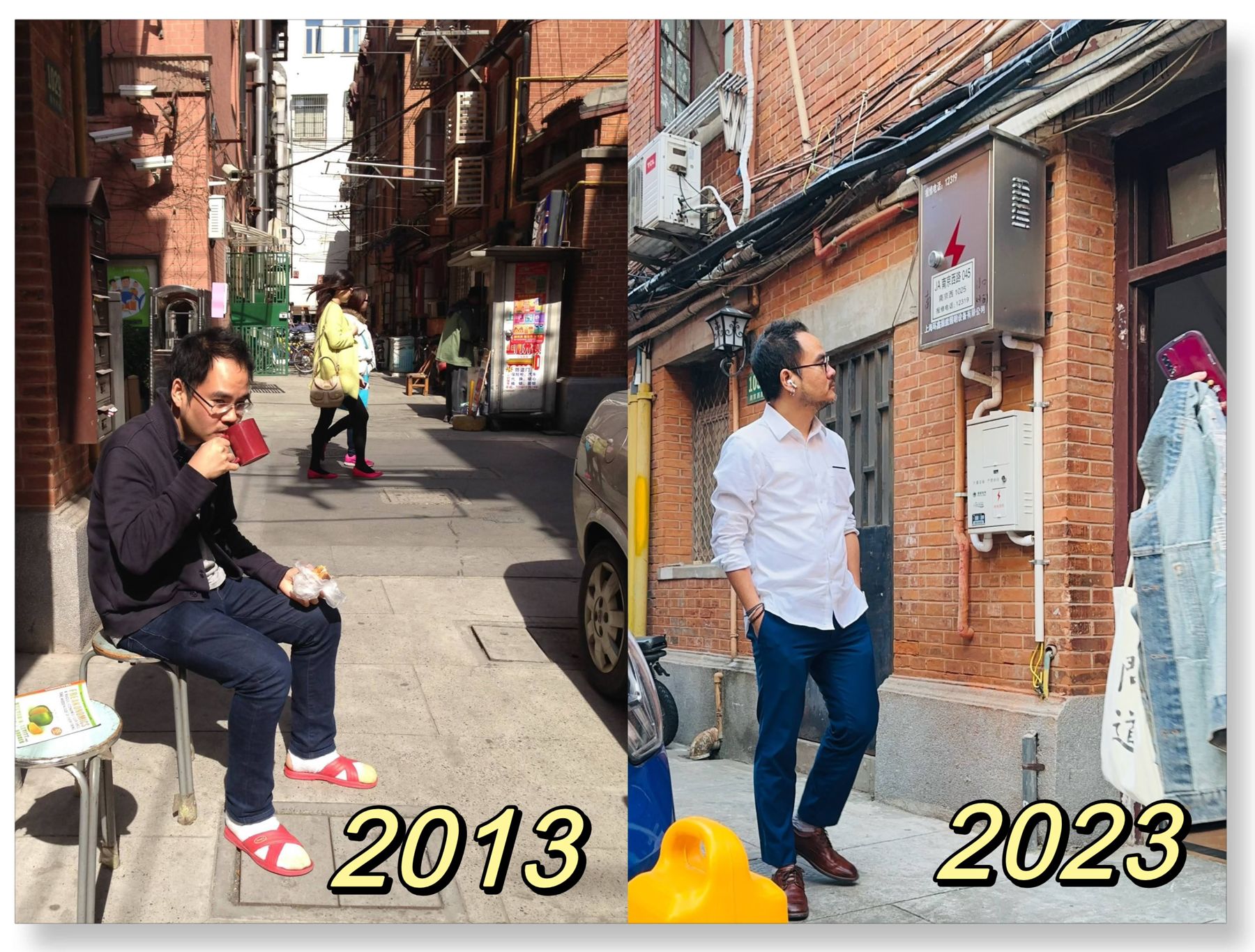
The Shanghai I returned to in 2023 was, by any measurable standard, a more efficient and more liveable city than the Shanghai I had left in 2016. The metro had grown into the most extensive urban rail network in the world. Cash had effectively disappeared as a medium of daily transaction; almost everything paid for in central Shanghai in 2023 was paid for with WeChat Pay or Alipay, through a QR code, on a device the user had taken out of a pocket. Ride-hailing services had replaced almost all taxi traffic, in fleets of nearly silent electric vehicles that had also, almost incidentally, halved the city’s audible street noise. The air was cleaner—not pristine, but visibly improved. The street markets I remembered as crowded with scooters parked on the pavement had been swept clean. An automated CCTV system did the sweeping. In some districts, friends told me, it would send you a photograph of your own illegally parked scooter within minutes, with a payment link attached. The same network read faces, plates, and the way people walked. It was reassuring and slightly disturbing at once, depending on which part of your life you would rather it did not watch.
Some of these changes had been narrated, in the years between my visits, by international press as a kind of dystopia. The book is not a polemic, so I should record that nearly every Shanghainese friend I spoke with on this trip described the same changes as improvements. The streets were quieter. The petty crime that had punctuated central Shanghai in 2016—the bag-snatchings on the metro, the gutter-oil restaurants, the unregistered scooters running pedestrians off the pavement—had largely vanished. The trade-off, when my friends discussed it openly, was treated as a trade-off. Some privacy lost; some safety gained. Reasonable people could disagree about whether the exchange was a fair one. Most of my friends told me they had concluded, over the four years of my absence, that it was.
Tranquil Light’s perimeter had also been transformed. In 2013 the city sent two dozen officers of the Urban Management Bureau through the compound gates and spent four hours dismantling the small commercial economy that had grown along the outer wall — the cafés, the design studios, the boutiques. The shuttering carried on quietly for another two years. It had held. The boutiques and design studios were gone. The Suzhou Creek warehouses I had passed every week in 2014 on my way to the public library had been converted, in the late 2010s, into art galleries and design hotels. That conversion was, on examination, a piece of textbook gentrification: industrial uses moved out, creative-class uses moved in, real-estate values appreciated, the original workers had no place left in the picture. I had walked along the creek on my 2023 visit. The walk was beautiful. The water was cleaner than I remembered. I thought, while walking, that I owed an honest reckoning with what I had been calling, for almost ten years, “gentrification from within.”
Sitting back in Bangkok in early 2024 to begin this rewrite, I had to admit something. The term “gentrification” is doing a great deal of moral work in the literature that does not always survive close inspection. The charge is partly accurate—classical gentrification really does displace working-class residents and really does, in net, make their lives worse—but it has also flattened a more interesting set of phenomena. The Suzhou Creek conversion. The Huai Hai Road retail collapse. The transformation of factory neighbourhoods into design districts. Each of these is what the literature would call gentrification. Each of them, on examination, has produced a different distribution of winners and losers than the classical Anglo-American case the term was built around. Some of the changes have been good for some of the residents involved. Some have been bad for other residents. The phenomenon is not, in 2026, a single thing.
What I argue in this book is that the configuration I observed in Tranquil Light—original residents capturing the gains of central-city heritage appreciation—is one variant of the larger family of urban-demographic-change processes that the term “gentrification” has been asked to name. The variant is interesting because the original residents are net winners. The variant is interesting because the demographic outcome is increased rather than decreased diversity. The variant is fragile, as the chapters of this book detail. But the variant exists, and it has held in Tranquil Light, and the reason it has held is something the local government has gradually learnt to stop trying to dismantle. Cities, when they are working, accumulate this kind of arrangement. The concept is one small contribution to that vocabulary.
I first published the concept in Asian Anthropology in 2016, and refined it two years later in Urban Studies under the heading “gentrification and its contentment.” I first wrote the term down in a draft article in 2015, sitting in my pavilion room with the door propped open for the breeze. I had worried about the same street in public once before that, in a 2012 essay that was mostly anxious about loss and had not yet worked out that some of the losing was actually winning; I mention it only to admit that the argument took its time arriving even inside my own head. In the years since I left Tranquil Light, the framework has been sharpened by people I have never met, working in cities I have never seen. The book is in their debt as well as the residents’.
One sentence keeps coming back to me when I think about the Shanghai of 2023 and the work I have been doing in Thailand since 2019. In cities, as in everything else, we trade something for something.
The lilong’s residents traded physical comfort for a social network with deep roots. The Shanghai of 2023 traded some privacy for a real gain in everyday safety. The residents of Nakhon Si Thammarat using @NakhonCity traded a little anonymity for a much faster answer when the drain floods. None of these trades is simple. None is the right trade in every place at every moment. Urban policy, in the version I have tried to practise, is mostly two things: being honest about what is being traded for what, and giving the people who live there a real say in which trades get made.
This book is, in its small way, a record of one set of trades, made over twenty-five years, by the residents of one Shanghai compound. They have remained where they are. They have done it by becoming the kind of community that is hard for the state to dismantle. They have done it through the patient daily work I describe in the chapters that follow. The book is for them.
It is also for the woman who walked the lanes of Tranquil Light with me on two trips between 2023 and 2025. On each visit she helped me see the compound with the eyes I had grown since 2016, rather than the ones I had then. Her name is Chollawan Wanichpan — “Plub” to those of us who love her. The book’s title sounds in English like a piece of social-science method. Between us it has become a small joke. We have been locating Shanghai for several years, and we have done it together. The city in this book is one of several Shanghais we have walked through. The others are not in the manuscript. They are in the writing of it.
Welcome to Tranquil Light. The lane is narrower than you think. The neighbour with the thermos of green tea is already on her way over.