Abstract
This chapter is the most physically descriptive in the book. It takes the reader inside the small, unusually south-facing pavilion room (tingzijian) the author rented for sixteen months in Tranquil Light, and describes – at the grain at which it was actually being lived – the daily rhythms, the shared bathroom and kitchen, the etiquette of the lane, and the year-long correspondence with Teacher Hu about a ninety-two-year-old landlord who would not lift a finger to repair anything. It also records, without ornament, the conditions under which intimacy was possible in eight square metres: the thin walls, the shared shower, the neighbours’ hearing, the bed that was too short and too loud, and one night a yeast infection that put two people in a hospital corridor after midnight because no gynaecologist was on duty. The chapter takes its title from Claude Lévi-Strauss’s Tristes Tropiques. It argues that the affective register of fieldwork in heritage housing – including desire, embarrassment, and the body’s veto – is itself ethnographic data, and that the anthropologist in the room is a human being, not a vantage.
Keywords: tingzijian, pavilion room, lilong, ethnography, intimacy, Pellow, Lu Xun, Lévi-Strauss, shared bathroom, Cultural Revolution, anthrotecture
I do not know if the three summers I spent in Shanghai were among the hottest in the city’s history – temperatures hit 38 Celsius for ten days running between mid-July and mid-August in 2013 – or if it only seemed that way because the room I had rented was never meant for human habitation. There were many afternoons that summer, lying on a bed I could not stretch out on without my head and feet touching the walls, when I questioned the entire research design.
I was saved, in those moments, by what one of my anthropology friends back in Cambridge called the dignity factor. ‘You’re doing real ethnography,’ she had said when I told her where I was going to live. The phrase, intended as encouragement, was harder to hold onto in the heat. By six in the morning the room was already 32 degrees. By two in the afternoon it was 36. The single small window – south-facing, which every neighbour assured me was a stroke of luck – did nothing. The wooden door was warped from a century of humidity and could not be fully closed even when I wanted privacy. By the second month of fieldwork I had been hospitalised twice – both times for an ear infection my doctor at the Renji clinic told me, with a faint smile, was almost certainly caused by the conditions of the room I slept in.
The room is the chapter’s main character. The lilong houses of central Shanghai have, over the past century of literary attention, accumulated a distinctive picturesque romance. The whitewashed brick. The stone-framed shikumen door. The little courtyard. The lane. Most of what has been written about the lilong, in English and in Chinese, has been written by people who have not lived in one, or who lived in one only briefly, in a renovated apartment several income brackets removed from the lives the chapter describes. I want to write something different. I want to write the lilong from the inside of an unrenovated tingzijian. I want to write it from the room.
The Tingzijian
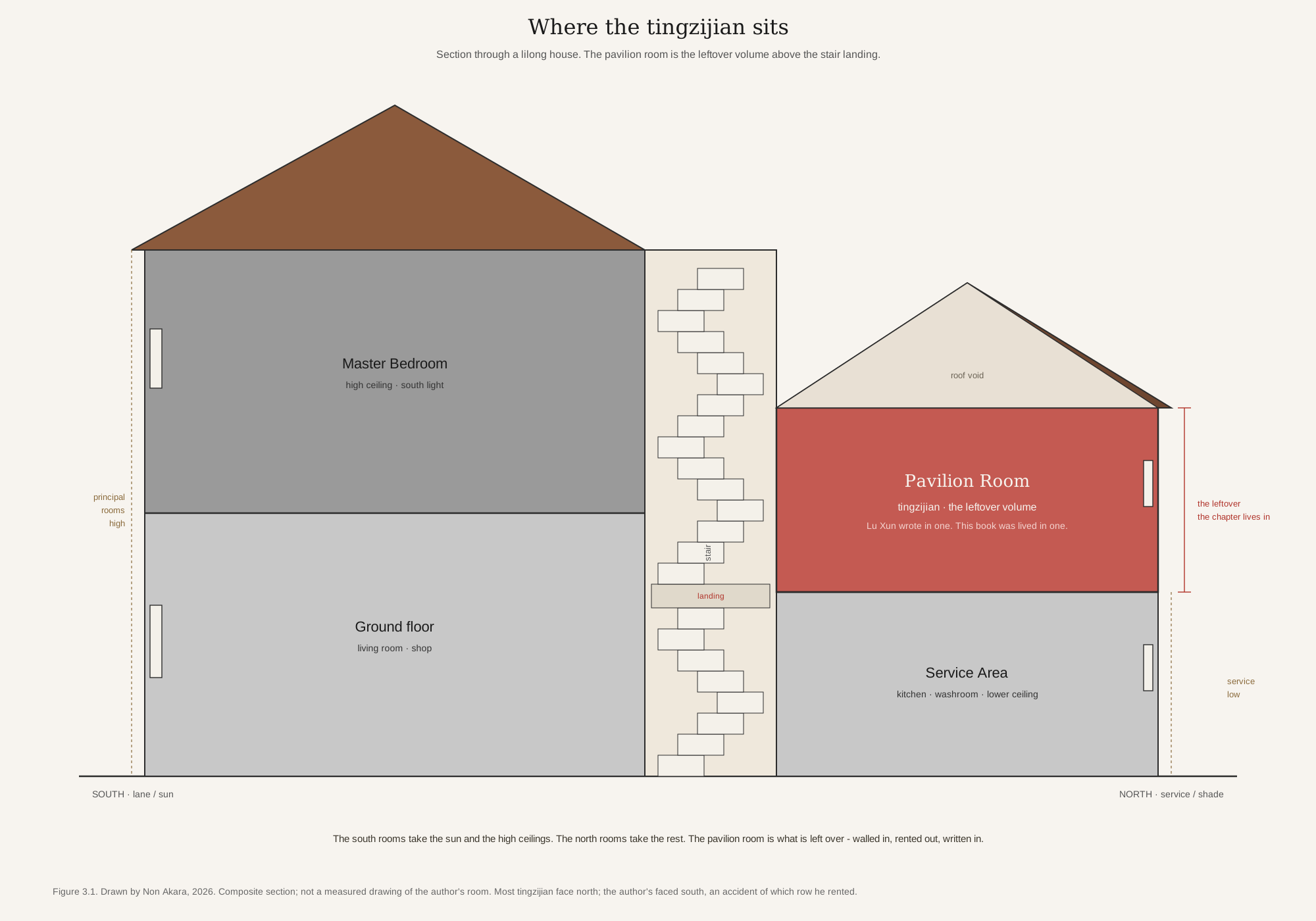
The pavilion room – tingzijian, literally ‘pavilion room’ – is a small interior space tucked above the rear stair landing of a Shanghai lilong house. It exists because of an asymmetry in the house’s section. The principal living rooms on each floor face south, where the sun is, and they have high ceilings to accommodate that orientation. The service spaces – the rear corridor, the kitchen, the bathroom on the floors that have one – face north and have lower ceilings. The lower ceilings of the service spaces, stacked against the higher ceilings of the principal rooms, leave a small awkward volume in section above each landing. The original developers, working in the late nineteenth and early twentieth centuries, decided not to leave that volume empty. They walled it in, gave it a small window, and called it a pavilion room. It became, in the original lilong typology, a storage closet, a guest bedroom, or – when the housing market overheated, which it did continuously – a rentable extra space.
By the 1920s, the pavilion rooms of Shanghai had developed a particular literary association. The cheap rent and the cramped conditions made them attractive to a certain kind of struggling writer. The novelist Lu Xun lived in one. Mao Dun lived in one. There is a whole genre of revolutionary writing produced in the 1920s and 1930s, by authors collectively known as the ‘pavilion-room literati’ (tingzijian wen ren), that was written in rooms like the one I rented. The conceit of the genre was that the pavilion-room writer, looking out from his small north-facing window at the rear of one row of houses, could see directly into the south-facing front rooms of the next row across the lane. He saw, in those front rooms, the moral hypocrisies of the bourgeois household – the opium addict, the philandering husband, the mahjong-table gambler – and he wrote those hypocrisies down. The pavilion room, in the genre, was both a habitation and a vantage. It put you in the back of one bourgeois house and gave you a front-row seat to the next.
I lived, for sixteen months, in a version of the same arrangement, with one correction the genre never had to make. Most pavilion rooms face north, for the reason just given – they sit above the service spaces, opposite the south-facing principal rooms. Mine faced south. My row happened to be the outermost one in the compound, its far wall giving directly onto the main street rather than onto another branch lane, and a row in that position has its geometry decided from the outside: the principal rooms had to front the street, which ran along the north side, which meant the service spaces – and the pavilion rooms stacked above them – ended up facing the compound’s interior instead. South. By the standard of the type I had a lucky room, and every other tenant on my lane knew it and told me so, usually with a trace of envy. The window still looked across a five-metre lane into the front bedroom of the house opposite, which is the detail that actually mattered. The neighbours who lived in that front bedroom were, for the duration of my fieldwork, an elderly couple I will call the Wangs. I did not see, from my window, opium or mistresses or mahjong. I saw the Wangs ironing. I saw them eating dinner. I saw them watching the evening news. I saw them sleeping. The room was, by 2013, no longer a bourgeois interior, so the vantage was not compromising. It was exact. From a pavilion room you can see across the lane, and the lilong is the only urban form in which that arrangement holds, whichever way the room happens to face.
The room itself was, by my measurement, just under eight square metres. The width matched my height almost exactly: I am five foot ten, and the bed had to be installed sideways across the room, on a custom wooden frame that was specifically built to fit the unusual width. To change the sheet I had to pick up the wooden frame, which weighed about ten kilograms, and lean it against the opposite wall. The frame stood twenty inches above the floor on four steel legs. Underneath it, when I moved in, I found a CRT television, four folding chairs, a folding mahjong table, a small stool, and a bundle of disconnected electrical wires. The landlord declined to remove any of them. ‘I don’t know when I may need them,’ he told me on the phone, ‘so I might as well keep them.’ They stayed underneath the bed for sixteen months.
My Landlord
My landlord was ninety-two when I rented the room from him in the spring of 2013. He did not live in the apartment; he had moved out years before, to a more comfortable arrangement with one of his children in Pudong, and rented the pavilion room out for the small income it produced. He came to the apartment exactly twice while I was there: once when I moved in and once, six months later, to collect his rent in cash because he did not trust the bank.
Teacher Hu, who had brokered the rental, gave me a careful introduction the first time. The landlord, he said, was a friend of Teacher Hu’s late father. They had both been senior chemists at the Shanghai Institute of Organic Chemistry – one of the first fifteen institutes founded by the Chinese Academy of Sciences in 1950. The landlord had graduated from Soochow University in the 1940s, before the Liberation, and was, in Teacher Hu’s account, ‘a brilliant man, but stubborn, and a little out of his time’ (bushangxingshi, a Shanghainese phrase that translates roughly as ‘not on top of the times’). The Cultural Revolution had been hard on him. He had emerged from it intact but, in Teacher Hu’s careful description, permanently rearranged. ‘Please understand him from a historical perspective,’ Teacher Hu said. ‘Don’t confront him with problems. If anything is broken, come to me.’
The room had been broken for some time. The parquet floor – original, mid-century, narrow strips of dark wood laid over a roughly levelled concrete slab – had shrunk over the decades into a grid of hairline gaps about a tenth of an inch wide and the same in depth. The gaps were too narrow for a finger and too small for a broom but exactly the right size to accumulate dust. The dust could not be vacuumed out without an industrial vacuum, which neither of us owned. The doctor at the clinic, when she diagnosed my second ear infection in early August, asked me what I had been sleeping on. I described the floor. She looked at me for a moment. ‘That’s the floor,’ she said. ‘That’s the floor doing it.’ She prescribed antibiotics and, with what I came to recognise as professional gentleness towards foreign anthropologists, suggested I consider another room.
The roof leaked when it rained heavily. Leaves clogged the exterior gutter. Water got into the wall through gaps between the bricks, despite the careful repointing the local government had done in 2009 in advance of the World Expo. The interior paint, which had been refreshed at the same time, peeled from the walls in long pale strips that, when they hit the floor, became dust upon contact. ‘That’s why the room is always dusty,’ my neighbour Mr. Liang said to me one evening, watching me sweep. ‘No matter how much you mop. The walls keep falling on the floor.’
There was one small architectural feature of the room that I came to admire, despite myself, because it was an artefact of my landlord’s earlier working life. The door of the pavilion room had originally been hinged to open inward, into the room. In the early 1960s, when the landlord’s family was first allocated the apartment under the danwei system and was struggling to fit five people into the available space, he had, in his own words, ‘realised this was such a waste.’ He reversed the hinges. The door now opened outward, into the stairwell. The reversal cost him nothing – the doorframe required no modification – and gained, by his calculation, almost exactly one square metre of usable floor area inside the room. ‘A square metre,’ he told me later, with quiet satisfaction, ‘meant my children no longer had to put their legs on top of each other when they slept.’
In the lilong houses of Shanghai during the high socialist period, where one family of five had been allocated a single former parlour, where two families shared an original bathroom, and where one square metre of additional usable floor area was the difference between sleeping with your legs intersecting and sleeping with them parallel – the architectural intelligence the older generation developed about how to extract usable space from a non-usable room is, even in 2026, the fundamental architectural intelligence of central Shanghai. My landlord’s door was a primer on that intelligence. The door’s outward swing into the stairwell, of course, also produced its own problems. It was a fire hazard. It encroached on the passage of the neighbours going up and down. On at least one occasion I nearly knocked Mr. Liang over with it as I came out and he, hidden in the narrow stair-landing’s blind spot, was hanging laundry.
The landlord, who had made his decision in 1963, had judged his own children’s sleep more important than his neighbours’ uninterrupted passage to the kitchen. The decision held into the 2010s.
The Bathroom
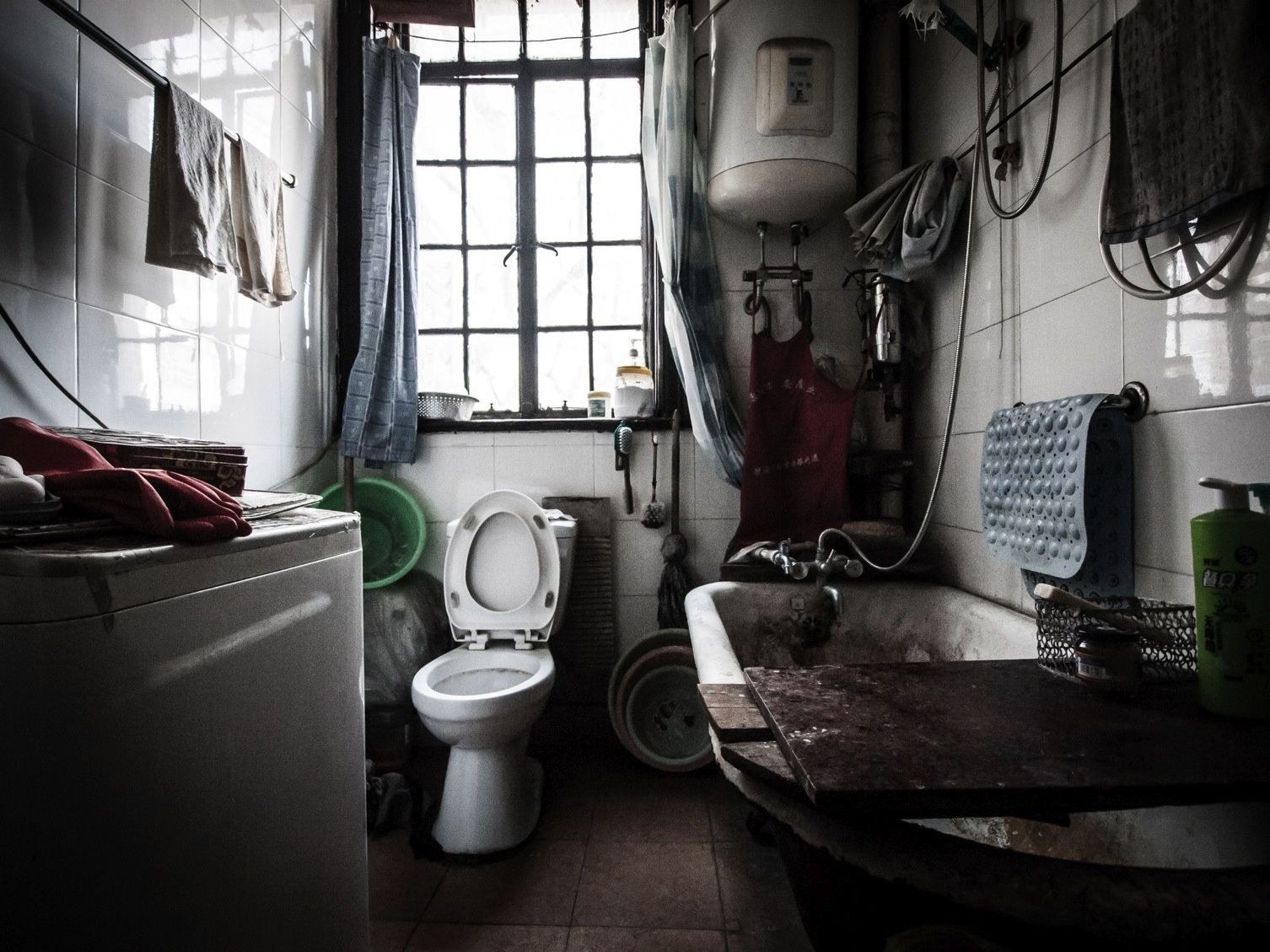
The bathroom on the second floor of my building was shared by five households, including mine. It contained: a stained porcelain bathtub of vintage 1930s, with one tap that worked and one that did not; a small sink at the far end; an old Chinese-domestic washing machine that belonged to the Liangs and that no one else was allowed to use; and three water boilers (reshuiji), bolted to the wall above the bathtub at slightly different heights.
The water boilers were, in their small way, one of the most exhausting features of my fieldwork. Each tenant on the floor was responsible for the electricity used to heat their own water; therefore each tenant had their own boiler. I did not know this when I moved in. I had assumed, on first inspection of the bathroom, that the three boilers were redundant systems for the use of all the bathroom’s users. On my first day in the apartment I turned on the boiler closest to me, ran a shower, and went back to my room. Within five minutes Mr. Liang knocked on my door. ‘That was our boiler,’ he said. ‘Ours is the one in the middle.’ He was kind about it, on that first day, as he was being kind about most of my early mistakes. Mrs. Liang was less kind. She had heard the distinctive sound of their machine through the thin wall that separated their bedroom from the bathroom, recognised the sound, and stood waiting for me to come out of the bathroom so she could explain my error in some detail.
I learned, over the next three weeks, the etiquette of the boilers. My boiler, the one closest to the door, was the oldest of the three and the slowest to heat. It took roughly thirty minutes to produce hot water and had a safety cutoff that made it impossible to keep running unattended. The Liangs’ boiler, in the middle, was a high-end model their daughter had given them as a gift two years before; it was the fastest. The third boiler belonged to a young couple in the back room who worked at a hotel and were almost never home; it was rarely used. The hierarchy of boilers paralleled, with a certain bleak comedy, the hierarchy of tenant tenure. The Liangs had been there longest. They had the best boiler. They knew when each of the other tenants used the bathroom, recognised the sound of each machine, and knew, instantly and with almost supernatural accuracy, when one of us had transgressed.
Mrs. Liang, in particular, had an additional relationship with the bathroom. It was, by the time I arrived in 2013, also Mrs. Liang’s secondary kitchen. The faucet over the bathtub was, on her floor, the only sink with running cold water. The kitchen on the second floor – a converted corridor about a metre wide containing a single gas stove – had no sink. So Mrs. Liang chopped vegetables in the bathroom. She washed the chicken she bought at the morning market in the bathroom. She did most of her dishes in the bathroom. She also, increasingly through the year I was there, did her hand laundry in the bathroom while watching the cars pass on the busy street through the window above the bathtub. The window did not have a curtain. The strange combination – porcelain bathtub, sink, washing machine, three water boilers, a cooking station for vegetables and chicken, and a panoramic window onto a luxury commercial street – made the second-floor bathroom one of the more cognitively unusual rooms I have ever spent time in.
It was also functional. The Liangs had been doing it this way for thirty years. They were healthy. The bathroom did not, by any measure I could detect, present a hygiene problem. The arrangement was, simply, the arrangement that had emerged over thirty years of two retirees adapting a 1930s lilong floor plan to their own evolving daily needs. The plan had not been designed for them. They had, with considerable patience, redesigned it for themselves.
No Place to Love
Pellow’s essay, written two decades before I rented the room, is still the paper that tells the truth about square metres in this city. There is, she argued, no place to live in the crowded inner districts, and therefore no place to love. I lived inside that sentence. I should say so, because a chapter that describes the heat, the dust, the shared lavatory, and the bulb rule, and then pretends that the room was only a research station, would be lying about the life that was actually being lived in it.
I had a girlfriend. Later, not at the same time, I had others. Bringing any of them ‘home’ required a conversation that does not appear in the housing literature. She had to understand, before she came, what a lilong was – that the steel gate and the brick wall were not a construction workers’ squat, that the compound was a neighbourhood with eighty years of occupancy behind it, that the room above the landing was small because the typology had made it small, not because I was camping. Once she understood that, most of them did not mind. Some of them liked it. A few of them, having seen it, did not want to return. That, too, is data.
The neighbours spotted every arrival. News in Tranquil Light travels at the speed of a kettle. Some of the older women at the gate smiled and asked, the next morning, whether the young lady had eaten. Some of them did not look at me at all. Shanghainese urban society is, in this register, more open than the foreign press usually allows: people knew I had visitors; they knew what the visits were for; they did not call the neighbourhood committee. They also did not pretend not to have heard.
We knew the walls. Sound moved through plaster and timber the way steam moved through the bathroom – without asking. The bed was a custom wooden frame, built to fit a room whose width matched my height, and it reported every shift of weight to the floor above. Below us, on the ground floor of a house that had originally been a shop-house, a luxury watch retailer had bought the right to occupy and decorate the street-level space. The second floor, where I slept, was still residential. The two uses were stacked, not joined. The frame made a sound the shop did not need to hear, and that the household above us did not want to hear. We learned, quickly, to leave the bed alone. The parquet – the same dusty, gapped floor that had already sent me to the clinic – was quieter. Missionary, on a bed that was too short, had to be done diagonally or not at all. Other positions were possible on the floor. None of this is picturesque. It is what eight square metres does to a body.
The window faced the lane. We closed it, even in the weeks when the room sat at thirty-six degrees and the fan did nothing, because the Wangs across the five metres of branch lane could see in, and because seeing in, in a compound where seeing in is the native optical condition of the pavilion room, was not a hypothetical. The lights went off for the same reason. In the dark I hit my head on the bookshelf more than once. Afterward we waited to shower. We could not shower together. A shared second-floor bathroom used by five households is not a place in which two people can be wet at the same time without the entire floor knowing by morning, and without that knowledge becoming, overnight, a story. We showered in turn, on our own boilers, drying the floor because Mrs. Liang would otherwise write a note. The notes about the bulb were already a genre. I did not need a new one.
We still managed. In winter, under a thick down blanket, with the window shut against a corridor that had no heating, the room could be almost kind. In summer it was often not. Sweat made everything rougher; the grease of two bodies in a room that could not ventilate was sometimes simply unpleasant. There is no elsewhere to go. That is Pellow’s point, and it is still true.
One night we had sex on the floor, as we usually did, because the frame would have advertised us to the shop and to the household above. Afterward she sat up and said, quietly, that she itched. The itch did not recede. Within an hour it was the only fact in the room: a burning, crawling itch that made it impossible to sit still, let alone to sleep, let alone to pretend that what we had just done had stayed inside the ethnography. We dressed. We walked out through the gate – the night watchman saw us; of course he did – and took a taxi to the nearest hospital that was still receiving. It was after midnight. The doctor on duty looked at us, looked at the clock, and told us to come back in the morning. There was no gynaecologist on the night shift. We sat in a corridor that smelled of disinfectant until we understood that sitting would not produce a gynaecologist. We went home. In the morning the diagnosis was a yeast infection. I cannot prove that the mould on the walls, the dust in the parquet, the shared bathtub, the closed window, or the heat caused it. Any of those would have been enough. What I can say is that the room did not remain atmosphere. It went with us into the taxi, and it sat with us under the fluorescent lights, and it was still itching when we came back through the steel gate at an hour when even Mrs. Liang was asleep.
One afternoon a handmade sign appeared on my wall – bad handwriting, up for perhaps an hour, then taken down by someone I never identified. I could not read it with confidence. I suspected it had to do with noise. I could not prove it. I record the suspicion because the alternative, in a chapter about a room, would be to pretend the room had no consequences.
I was frustrated, at first, in the way a tenant is frustrated: I was paying rent; I was young; the people around me had been there since the danwei years and would be there until they died. Later I understood the asymmetry more cleanly. I was passing through. They were not. A matchmaker at the kiosk, talking not about me but about the marriage market in general, put the older generation’s view of romance in a sentence I wrote down that afternoon: there was no such thing as romance in China, she said; people married to look respectable, to have children to pass things on to, and to have sex at home without going to a brothel. Hearing people in their thirties and early twenties through a wall was not, in that account, a charming overflow of life. It was a reminder of a bargain the listeners had already struck, and of one they had not.
Some of the women who came back liked the quiet that the walls required – the slower, more careful version of the same thing. Some of them did not want the dust, or the mould, or the ear infection I had already had twice, or a yeast infection at midnight with no gynaecologist in the building. The room left marks on more than one relationship, and not only mine. I could not, by the autumn of 2014, when I packed the two suitcases, imagine building a lasting sexual life in that room, let alone a family. I cannot imagine it more easily now.
Anthropologists are fond of claiming a superpower: that they stand on the shoulders of giants and therefore see further than other people. I have read the giants. I have also sat in a hospital corridor at one in the morning because the room I was using as a research station had done something to a woman I loved. If there is a vantage in that, I will not claim it. Maybe I could. I will not. I am a human being, as my readers are. The discipline that pretends otherwise – that treats qualitative work as a licence to arrive, to criticise, and to leave, with the data anonymised past the point of checking – is the discipline this book is written against. Anthropology is not a vow of abstinence, and it is not a perch. It is a method that puts a body in a place and then has to tell the truth about what the place did to the body. The heroism, if anyone is still looking for it, is not in the staying. It is in not pretending the staying was only intellectual.
The Light Bulb Rule
The five-foot-wide interior corridor that ran between my room and the bathroom had three incandescent light bulbs hanging from the ceiling. When I first noticed them, I assumed the multiplicity was about lighting density – the corridor was long, three bulbs lit it more evenly than one. This was wrong. The three bulbs belonged to three different households. Each had its own switch. Each was paid for, individually, by the electricity meter of the household that had installed it.
Turning on someone else’s bulb was, in the building’s economy, a meaningful offence. I learned this the third day I was there. I was walking from my room to the kitchen at six in the morning to make coffee. The corridor was dark. I reached for the switch nearest to my door and flipped it on. The bulb that lit up was the Liangs’.
Mrs. Liang heard the click of the switch through the wall – she heard everything that happened on the second floor – and was at her doorway within seconds. She did not immediately scold me. On that first occasion she only laughed, patted my shoulder, and explained the bulb arrangement carefully so that the foreigner in the apartment would understand. ‘That’s our bulb,’ she said. ‘This,’ pointing one over, ‘is yours. This,’ pointing two over, ‘is the back room’s. Each tenant has their own. So if you turn on ours, we pay.’ She went back to her room. I tried to use my own bulb, then realised that the switch to my own bulb was not where I had assumed it was. I asked. Mrs. Liang explained the bulb arrangement again, with a small additional flourish of impatience. I tried again. I succeeded. The corridor was, very briefly, lit by my own electricity.
I made the bulb mistake, by my own count, twenty-three more times. The switches were arranged, irrationally, in two horizontal rows on the same wall. Mine was on the upper row, the Liangs’ was on the lower row directly underneath, and I almost never remembered which was which when I came down the stair half-asleep at six in the morning. Each subsequent mistake was met with diminishing patience. Mrs. Liang began, after the third or fourth time, to scold me at length. By the eighth or ninth time, she had moved on to written complaints – small notes, pinned to my door in the morning, written on the back of recycled tear-off calendar pages, in cursive Shanghainese characters that I could only sometimes read. The notes addressed not only the bulb problem but a cumulative roster of grievances: the toilet paper roll I had left on the bathroom counter that took up space they considered theirs; the slightly damp bathroom floor I had failed to dry after a shower; the time I had run my own water boiler for more than thirty minutes in a single morning, which Mrs. Liang considered profligate. Mr. Liang, more apologetic, took the notes off my door before I read them, on most occasions, so that I would not be embarrassed. I would find the small rectangles of recycled calendar paper folded and placed on the small shelf by the bathroom in the evening.
None of this – the bulb scolding, the notes, the cumulative inventory of small infractions – was, in the actual texture of life on the second floor, hostile. The Liangs were, on balance, kind to me. They invited me to dinner several times. Mrs. Liang occasionally made small dumplings on Sunday mornings and brought a bowl to my door. Mr. Liang, who was a serious man with a quiet manner and a long memory for state policy, was, after several months, willing to discuss with me the exact mechanics of the work-unit housing allocation system in the late 1960s in a way that no formal interview had ever produced. The corridor, the bathroom, the bulb, the notes – these were not the symptoms of a hostile relationship. They were the texture of a relationship that had been forced, by circumstances none of the involved parties had chosen, to absorb a foreigner into a building’s seventy-year-old domestic arrangement.
What I learned, slowly, was that this texture was the building’s main social technology. The bulb rule, the notes, the bathroom etiquette – these were not residual relics of a pre-modern Chinese sociality. They were the ongoing daily work of three generations of residents who, having had to share a building they had not chosen to share with people they had not chosen to share it with, had developed a set of agreements precise down to the light bulb: who paid for what, who used what at which hour, and who was allowed to scold whom. The agreements were unwritten almost everywhere. They were enforced almost everywhere. They worked almost everywhere. They had been working, in slightly different forms, since the 1950s.
Sad Tropes
Living in the room was, for sixteen months, often genuinely difficult. The summer heat. The winter cold – lacking central heating, lacking the electrical capacity to run a space heater without blowing the floor’s fuse, I would write at my small desk wearing four layers and a pair of gloves while watching my own breath condense. The lack of privacy. The constant attention, which sometimes flattered the foreign anthropologist and sometimes pressed in on him in ways that were not generative. The hospitalisations.
What was harder than any of those things, in retrospect, was something less tangible. It was the lack of any private space in which to process what I was learning each day. I would come back from a long afternoon at Teacher Hu’s shop, having heard six new stories about the relocation negotiations of three different households, and have nowhere to sit and think them through. I would open my fieldnote document on a small laptop balanced on the bed. The bed would be hot. The neighbour on the third floor would be playing a soap opera at full volume. The Liangs, alerted by my returning footsteps, would knock with a question about the bathroom. The fieldnotes, when I produced them, were always written under conditions of mild duress. I am not sure, even now, what they would have looked like if I had had a quiet office.
The title of this chapter is borrowed from Claude Lévi-Strauss’s Tristes Tropiques. Lévi-Strauss was, of course, working in different conditions: a remote part of Brazil in the 1930s, far from any nation-state’s surveillance, on a project that has been read for two generations as one of the most important anthropological documents of the twentieth century. I am not putting my pavilion room in 2013 on the same scale. I am taking from his title only its small affective insistence: that the discipline, as practised from the inside, is sometimes simply hard. That sadness – the affective texture of fieldwork done under conditions one would not choose – is not a confession to be apologised for. It is, in some way I cannot fully articulate, part of what produces the data.
There is also a particular kind of surveillance the Chinese state imposes on a foreign researcher in conditions like these that bears mention, briefly, because it shaped what I was able and willing to write at the time. About a month after I arrived in Shanghai in 2013, the local authorities launched a publicised crackdown on what was being called ‘sojourning foreigners’ – visitors who had overstayed visas, lived in unregistered residential units, or otherwise failed to comply with the formal residency requirements. Several foreigners I knew tangentially were fined, deported, or forced to relocate. One acquaintance – an American student on a gap year living in a privately rented lilong apartment with no formal registration – was fined heavily and deported within the year. ‘Just stay in the university dorm if I were you,’ he said to me at a small farewell dinner. ‘The local government doesn’t trust foreigners.’
I had, on my own paperwork, the appropriate registrations: a research visa, a registration with the local police station, an affiliation with Fudan University, a record of my address with the neighbourhood committee. The paperwork made the surveillance no less real. The neighbourhood committee visited me four times over the course of fieldwork. I was asked, on each occasion, what kind of social research I was doing, what I was writing, who I was talking to, what my conclusions were, when I would be leaving. The questions were polite. They were not, to me, neutral. The surveillance was the texture of the room, in the way the heat was, and the bulb was, and the floor was. It is part of what the room produced.
Why I Stayed
Why did I stay sixteen months in conditions I would not have chosen if any other option had existed?
There was a methodological answer. The lilong’s residents, including the Liangs and Teacher Hu, would not have spoken to me with the directness they did if I had been visiting from a hotel or from a university dormitory in the suburbs. The trust they extended me, in the rare moments when they extended it, was the trust of a co-resident. The bulb mistakes and the bathroom etiquette and the dust and the heat were the conditions under which that trust accrued. I do not think I could have produced the same chapter, or any of the chapters that follow, from a hotel.
There was also a more honest answer, which is that I did not always know how hard the conditions were going to be when I committed to them. I had signed the lease in May. By July I was in the room. By August I had been hospitalised twice. The lease, in the local Shanghai practice, was for a year. I could have broken it. I could have moved to the dormitory my American friend had recommended. I did not, partly because I was stubborn, partly because my advisor Ted Bestor had taught me that the city was wherever I was sitting in the city, and partly because I had begun, by the second month, to like the building. I liked the Liangs. I liked Teacher Hu. I liked the Wangs across the lane. I liked the small daily rituals of the corridor. The room itself I never liked. The building, despite the room, I came to feel something like affection for.
I moved out in November of 2014. The moving did not take long; everything I owned in the apartment fit into two suitcases. I left the four folding chairs and the CRT television under the bed where the landlord had put them, because the landlord had said to leave them. The Liangs, on the morning I left, gave me a small bag of dried mushrooms from their hometown. Mr. Liang shook my hand. Mrs. Liang patted my shoulder. They asked when I would visit again. I said as soon as I could. I have visited several times since.